590. Are American Tech Billionaires Beyond All Control?
Listen to episode
Episode Summary
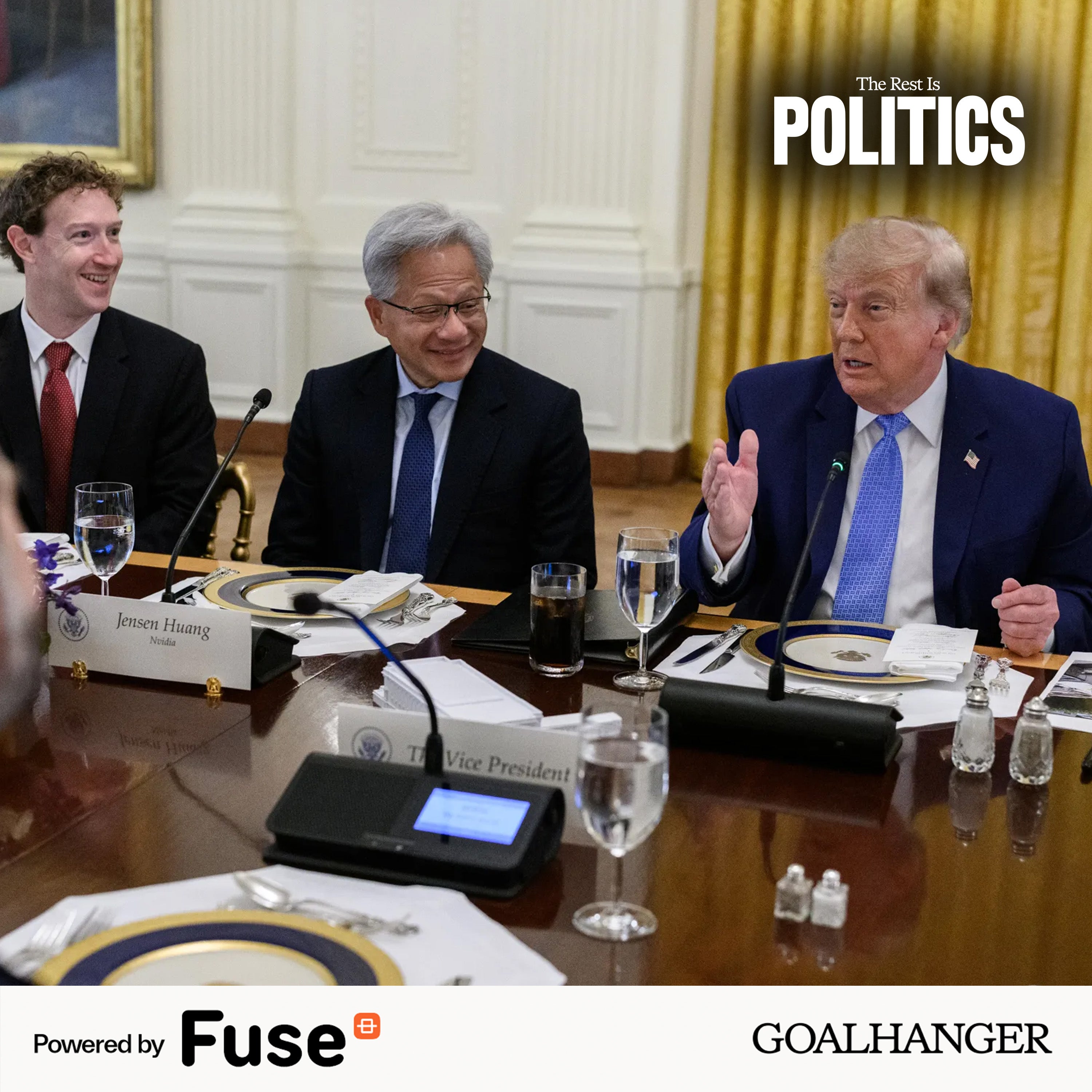
In this episode of the podcast, Rory Stewart and Marina Hyde discuss the recent resignation of Jensen Huang from NVIDIA, the implications of wealth and power in the tech industry, and the evolving relationship between technology and politics. They explore how the personalities of tech leaders like Mark Zuckerberg and Elon Musk influence their companies and the broader cultural landscape. The conversation also touches on environmental concerns, the challenges of AI regulation, and the complexities of personal relationships within the tech elite.
Key Topics
Full Transcript
Welcome to the rest of this politics question time, I'm Rory Stewart. And me, Marina Hyde. So, Marina, today, so much to discuss, but I wanted, given that you've done a lot on the tech bros, to begin with this extraordinary story about Jensen Huang stepping down from the most valuable company on earth. I then wanted to move on to talk a little bit about communication in politics, about what makes politicians tick, how Trump performs, how Andy Burnham performs, how politics is being changed by the world of entertainment. Then I thought maybe after the break, we'd talk a little bit about the environment. COP is happening. Why is it that environmental climate change seems to be dropping down people's list of priorities so fast? Welcome, welcome, welcome. Thank you. Amazing. First time I've ever done it without Alastair, so nervous moment for me. Thank you for coming. I know it's like going to the theater and you have the understudy and it says Sir Ian McKellen is unavailable tonight. The part of King Lear will instead be played by Steven Seagal, which I would watch. Would be great. Yeah. Would be great. Yeah. Would be great. That's like the chef. Is that that guy? Yeah. He's the chef. He's a chef in one movie, Under Siege. Yes. He also cooks. He's a former Navy SEAL. I believe a real privilege to have you on because actually there's also a bit, you know, we like a bit of promotion here on the show. Something is happening because you have just launched a new product called... It's called Always On. Always On. Because I am always on, even on your podcast. Yes. I have all my writing you can find now at marinahyde.com and I have also launched a new show called Always On where I've covered this in sort of some of the stuff we're going to talk about. So I think in episodes on YouTube, you can get it wherever you get your podcasts. If you just search Marina Hyde, Always On. And yeah. And people can still listen to you on the Restless Entertainment. Of course. It's my first love. They can always listen to me on Restless Entertainment. Restless Entertainment for the double act and for the solo Marina Act, Always On. Always On and writing at marinahyde.com. I am quite literally always on. I mean, really. Now, question for you. Hit me. How much does it matter that the people running the biggest tech companies from Robin seem to operate in a reality pretty warped by their own wealth and power? Is that distortion actually changing politics? How's it changing culture? So let's start with kind of warping. Do you think they are pretty warped by that? And what's warping? I don't know. Peter Thiel literally believes in the Antichrist. So yeah, that to me seems a comparatively extreme position for someone whose technology is kind of knit into all of our states quite deeply and seem to be becoming more so. This episode is powered by Fuse Energy. Fuse Energy is rated 4.9 on Trustpilot, higher than any other UK energy supplier. And it's easy to see why. Fuse offers some of the lowest tariffs on the market, and that feels even more important given the energy price cap is set to rise by 29% in January. This is when energy policy stops being an abstract debate and starts showing up on your bills. Yet many of us seem to be a bit too accepting of very expensive energy bills because switching providers can feel like an unnecessary hassle. Fuse wants you to expect more from your energy provider, and it only takes three minutes to switch. And with day and night customer support, you can get your questions answered whenever you need. You don't have to choose between cheap energy and great service. As an extra incentive for our listeners to switch to the number one energy supplier on Trustpilot at fuseenergy.com slash politics and use the code politics for a free trip plus subscription. Visit fuseenergy.com for full terms and conditions. With someone like Mark Zuckerberg, who became incredibly successful when he was very young, it's often said of celebrities that their development freezes in time at the moment they become famous. And this is why Charles Stiles have very different. Can I interrupt? Yes. I mean, this is really interesting because you're right, Zuckerberg becomes super rich when he's sort of 20, 21. And Musk a bit later, but it's still pretty young. I mean, he's a pretty big deal when he's in his late 20s. And this will be true for a lot of these people. I mean, I just saw a guy called Leopold Aschenberger, who is like 26 and just set up this thing, a multi-billion dollar fund. Why is it, do you think, that people are sort of frozen at the moment they become famous? Is there a kind of psychological mechanism which... You stop hearing the word no a lot. I mean, almost entirely. And the way they set up their companies, actually, someone like Jensen Wang is... It was a slower burn, wasn't it? Yeah. And he actually, because he became... But because he's been running that for much longer, you know, he can be ousted by his board. Zuckerberg's now... They've all set up their worlds now with these kind of super-voting shares that if Zuckerberg was ousted from his company, I think he could just say, well, I tell you what, I don't accept that and we'll have a different board who will reinstate me. And I think that they live in a... That actually some of the younger ones or the ones whose companies, who are going at it less long than Jensen Wang, are set up now in a way that they've had impunity sort of hardwired into their corporate structures. I think it's really interesting, but they don't hear no at all. They are like sort of megastars. And so, as you've often said, this is an incredible amount of unaccountable wealth and power, right? NVIDIA, from which Jensen Wang has just been fired, hit $4 trillion, biggest company in the world. 5.7 it was at one point. The only national economies that are bigger than NVIDIA are the U.S. and China. Incredible. It's extraordinary. So much bigger than the British economy, bigger than the German economy. Yeah. And when people talk about, you know, oh, it's like the Gilded Age, it's like those of all those guys had, they might have been monsters in many ways. In fact, they were, but they had an amazing cultural mission as well. You know, if you think of Carnegie and the libraries and all these sorts of things, you're not at all aware that these guys have any form of cultural life at all, a hinterland. And there's a reason we call it a hinterland. It's, you know, it's something that backs you up. It's something that's different. You never think of them as having anything like that at all. And furthermore, they are so much more powerful. Like Standard Oil is nothing compared to these companies, nothing. Standard Oil, which was a big monopoly and they broke it up in 1911, something like that. That was far, far smaller than these people could ever be. We can't, we've not really lived in an era of power like this. They're bigger than all, I remember reading a really interesting book by someone who was sort of like the 40th employee or something of Facebook and she, it's called Boy Kings and it's a memory of her time. And there's a point where she is sort of hired to sort of sublimate Mark Zuckerberg's floating thoughts into some form of corporate philosophy. And he'll just sort of walk by her and say things like companies, not countries and whatever it is. So we've never really treated these people in the way that they should have been. And they were also never scrutinized. They were not scrutinized in the manner of heads of state or world leaders as they should have been. And it was always talked about as cuddly inventors, like, oh, look at this kid who still dresses in this funny way. And, you know, we invented this tool to socially connect people in his dorm room or look at Elon Musk. He's a sort of cuddly inventor. And it was only when things that got far too out of hand and they did amass far too much power that people started realizing like, oh my God, this person is so much more important than a number of world leaders. One thing that comes out of this when we look at Jensen Huang is it turns out that one of the things that was suddenly revealed when it came to the time for people calling for him to be fired is that his board had kind of been in place since NVIDIA was a much smaller company. So, you know, again, for listeners, just to explain, NVIDIA is a chip maker and it began designing chips for video games. And by complete accident, basically, it turned out that these chips designed for video games were perfect for the new fashion of AI, which was this large language model. Transformer architecture AI really worked very, very well on these advanced video gaming chips. So NVIDIA, which he's been at for like more than 30 years. And when you look at his board, suddenly all these kind of old corporate dudes that I talked to completely shocked because normally the boards, the biggest companies in the world, they're always like an ex-secretary of the treasury, the ex-CEO of Walmart. They're kind of these big, old kind of establishment figures. Not so. These are these kind of dudes who were friends of Jensen 20 years ago. You're never really going to, once you're getting to a five trillion valuation, you're never really going to say, you know what, I think someone else would do this job better than me. Exactly. So they sort of stuck around. Another version of this that I came across was with OpenAI. So OpenAI, again, the company that makes ChatGBT. And people will remember this incredible moment a couple of years ago where they fired Sam Altman, who's the CEO, and they fired him on the grounds that he was taking incredible risks and they thought what he was building was unbelievably dangerous and he was deceitful. So the board did what boards theoretically, the only thing they're really meant to do, which is get rid of their CEO. But it turned out that the board did it in such a cat kind of way. They forgot to keep minutes. They didn't follow proper legal procedure. And within a week, Sam Altman's back and the whole board's been thrown out. Yeah. Well, that's what will happen with Zuckerberg. That's what will happen with any of them now. These guys who set them up to have the super voting shares, which lots of them did later on, those guys now live in an age of impunity. And we saw this with Elon Musk that when he did his big SpaceX launch, it was set up that you could buy shares in it, but you weren't going to have any control of it. And now we see that Jensen Huang is trying to get back in again. There's a big move now to get Jensen Huang back into NVIDIA. And this whole question of are these people or are they not indispensable, but it's really, really weird because they have been so successful at making people parrot their lines and their lines are, you can't regulate us. Regulation is Luddite. And if you're regulating us, you're against technology and you're against innovation. And they have this fantastic argumentative style where they say, what do you want to regulate then? Do you understand this? Which bit of transformer architecture do you want to regulate? Oh, which bit of the weights and parameters do you want to regulate? Do you understand what you're regulating? And so they've got this incredible thing where they're able to move from a sort of techno optimism to then relying on incredibly specific technical details, which nobody else can keep up with to try to circumvent this. And I mean, when you're looking at these people on Capitol Hill, these committees, and you see these absolutely ancient politicians sort of shuffling in because they won't make way, the gerontocracy who's supposed to somehow say, well, yeah, actually, that is the bit I'm interested in. And let's get really deep on that. But they can't because they can't even understand what the technology is in the first place. You can see it even in our own parliamentary committees when they're scrutinizing something. I've appeared before one not that long ago, and I was quite shocked by how little they knew. I was just talking about charter renewal, how little some members of the committee knew, honestly, just about television and how things rated and how much of our country actually watched Netflix. That's on something so basic that it would really be very, very easy to find out. They could have just asked a chap, but they hadn't. Okay. So we have this big scandal in which it is alleged that Jensen Huang's girlfriend, mistress, it seems clear that he was having an affair with her. It's alleged by people in the American intelligence agencies that she was a Chinese state asset. So pretty unclear what that means. Does that mean that she was working for a business and they recruited her or she was a Chinese spy who was put into this business? And what was she trying to do? Was she trying to influence his policy? Was she trying to find out industrial secrets or was she simply a route of smuggling? Top line, it's bad. Top line, it's bad, Rory. Top line, it's bad. So what's your sense of how all the others are responding to this whole thing? Well, I'm sure they're bitching behind his back, but in public, you know, they've rallied round. The broligarchy has rallied round. And I find it really extraordinary. Some of the people, you know, Trump just saying, oh, you know, he dealt with her, but everyone does it. Thank you so much, Mr. President. Bill Ackman saying, you know, we just need to support him and his family now onwards. First of all, I don't think it's my job to support this guy and his family. You know, I'm sorry for his wife, but that's their business. Then like Sean McGuire saying he's completely, he's a big tech investor saying he's completely indispensable to America's AI leadership. And Elon Musk saying, I agree. It's like it hasn't affected the broligarchy friendship group at all. And there's sort of circling the wagons and just saying, oh, it just doesn't matter. You know, Elon Musk probably tweeted 3000 times about the odyssey, but doesn't think this is important. And if they decide it's not important, you know, that guy, Nikita Beer, who used to run most of X, he said, I just thought I'm going to read this quote because I find it so hysterical. He said about Jensen Wang, the fact he only had one extramarital affair with a state asset after leading the greatest technological revolution in history is what impresses me. For anyone else, that number will be double, even triple digits, triple digit affairs with foreign state assets. I don't know. How would you run that? Well, so I know Jensen Wang a little bit. And I think the first thing that I'd push back on a bit is they're not really a group of friends. I mean, they massively hate each other, most of them. I mean, one of the weird things about the ways that I spend quite a lot of time in Silicon Valley with these people, and one of the things that's so striking, yeah, is that they're not a unit with the same view of the world. They're actually people who have a lot in common, but they have such deep resentment and suspicion towards each other. And in a sense, the whole AI industry is the story of people who are really against each other. The beginnings of OpenAI come out of effectively Elon Musk and then Sam Altman getting very angry with Demis Hassabis and Larry Page at Google and thinking that what they're going to build is really evil. Then Sam breaks with Musk. Then Dario Modi, who's part of Sam's setup, leaves in disgust and sets up his own company saying Sam Altman is a massive threat to humanity. Then the board of OpenAI, which includes people like Greg Brockman, his friends, fire him, put in his other friend as the CEO, who then resigns, he comes back. And then Dario Modi and Jensen Huang, I mean, unbelievable. I mean, I was at a conference with Jensen Huang recently where he was saying everything that Anthropocene was saying was complete nonsense. AI models don't pose any kind of threat. This is an easy engineering problem to solve. This is all scaremongering, etc. So part of the thing going on in the back of my mind is the extent to which really the story may not be here is the genuine national security threat and all the tech bros are defending him so much as actually this is something that will delight an enormous number of the tech bros, particularly people like Dario, who really disagreed about him selling Nvidia chips to China and, yeah, everybody hated Nvidia. But why aren't they saying it publicly? If they circle the wagons, actually, isn't that what, they must be doing it for a reason. I get that they all love to pick up the phone to each other and bitch about each other, just like all those billionaires did with Trump in his first term when they used to call him at night and then just put the phone down and say, oh, he's such an idiot, to the next one. I get that they do that and that it's kind of like high school and it's really mean. With the exception of, I mean, so obviously some of those people are not tech bros. Bill Ackman's not a tech bro. He's a big tech investor. A big tech investor. He's kind of the right wing infrastructure, but he's like an elderly investor. He's not part of the kind of engineer Silicon Valley group. Within the engineer Silicon Valley group, a lot of them won't even sit in a room with each other. I mean, that's one of the reasons why it's almost impossible to do the safety stuff is that you can't actually sit around a table and when they do sit around a table, they literally talk past each other with these kind of radically different agendas. I mean, Giving the impression of being, then they can feel like a woman in a meeting. I know there aren't any women in the meetings. There aren't any. There aren't any women. It's lucky there aren't any women. They have to talk past each other. That's for sure. So let me come back on the Chinese state asset thing. Jensen Huang has forever been completely open about saying he wants to sell more chips to China. There's been no secret about it at all. I've seen him standing up again and again saying sell chips to China and for at least four years, he's been the bogeyman for the people like Darryl Mota who don't want to sell chips to China. So, and that's my first thing. So there's no secret here about what he was doing. The second thing is what's the claim about what... There is something around the edge of it, isn't there? If you're not allowed to sell chips to China, you may say that you wish to do it, but if they found a way to go via Megaspeed, which was this woman's company or whatever, and people are saying it's $12 billion worth of chips, then that's a different thing. That is covert. Yes, exactly. So if the claim is that what's happened is that for whatever reason, either because he fancied her or because he was... I think he didn't more than fancy her. I'm going to have to break this to you. Exactly. But is that the motivation or is it that he's working for the Chinese government? So if he has, and maybe has, illegally broken U.S. sanctions by deliberately smuggling forbidden chips through this company to China, that I would think is the story, but I would be very surprised if he was doing it because he was somehow a Chinese state asset by being manipulated by the Chinese intelligence service. I'd imagine he's actually... What we know is that he's been desperate to... Well, there's been the other joke, which is the Chinese refusing to buy his chips. I mean, there's a very weird thing going on where he's been saying, we've got to get the Chinese to buy my chips because then they will be totally dependent on the U.S. and we'll be able to weaponize that dependency and they'll never develop their own industry. And it's really good for the U.S. if China's dependent on American chips. And the Chinese, of course, hear that and they're like, okay, we don't want to buy your chips because we want to develop our own chips. So with these spy stories, I don't know what's going on. I think there's a very strong bit of the Democratic Party that doesn't like selling chips to China, doesn't like Jensen Huang, have found a connection between this woman and the Chinese intelligence agency, but that they somehow dressed it up as though he's somehow a Chinese state asset or he's leaked industrial secrets to China. You're saying the main thing is the smuggling. Yes. If there's something... Yes. I have to say, I'm still an old-fashioned person that believes if you are having an affair with a state asset, it is a biggie. It is still a bad thing. And saying, oh, it doesn't matter and that everyone has affairs or triple-digit affairs with state assets seems to me kind of a weird position to take. But with all of these people, anyone who is too big to fail as an individual and that, I mean, NVIDIA is such an extraordinary thing. I read this thing in The Economist that 15 cents of every dollar made by the U.S. stock market since 2023 has been NVIDIA stock. I mean, I think that what we've done for a really long time with these guys, and what's weird is that we're seeing the movie again. We did it with the sort of first generation of these guys, Zuckerberg and all the social media guys. And now the same thing is happening again where they say, oh, we must grow at all costs. We can't talk to you about it or one of our models has escaped its boundaries. We don't really, you know, no one really knows what we're building, but we have to be permitted to do whatever we want or else we'll be eaten by the other side's technology. And you can see now it's really filtered through and obviously we saw in the midterms, but you see everywhere people thinking, hang on a second, I'm just not, people are really skeptical about it now because of the way that they behaved and also because we've seen this movie before. The AI thing I think is really weird because it seems to me that it's possible that it's a complete irrational fantasy. So $750 billion odd is supposed to go into this technology. And I was sitting with some Japanese business people on Friday who were saying that they had completely missed the AI race 10 years ago because when they were encouraged by Shinzo Abe to push ahead with it, they pointed out that there's no income stream, that there's no revenue attached to this thing. It's very difficult to work out how you make money out of it or big money out of it. And we're recording this before the IPO for Anthropic, which is supposed to be going for about $1.4 trillion, so $1,400 billion. And its actual annual revenue is a tiny fraction of that. So the only way it can justify that valuation is somehow if it's doing something that nobody can define. And one of the interesting things is that although there's been huge progress on solving fundamental maths problems and on coding, the rest of it, it's quite difficult to see. You could imagine maybe a valuation, I don't know, of $200 billion, not $1.4 trillion. So what's happened? I mean, how have all these investors, all these companies, all these politicians essentially been sucked into a sort of... The fantasies were very few, kind of slightly sci-fi, weird, geeky engineers who want to build a kind of superintelligence. How did that happen? It's hard to say, isn't it? But it's like it could be a bubble. We don't know. But we're so deep into it now. The circular financing is so extraordinary, the way Nvidia have structured everything. People have to pay their money and then they'll invest in your company so that you can buy more chips. And it's really interesting now, I think, the language that's around it. It reminds me of the language when people, obviously in the midterms, when people were saying, we don't want a data center anywhere near us. This is what people would have said of a nuclear reactor. I don't want a nuclear reactor anywhere near me. It reminds me of a lot of the kind of Cold War nuclear era panic about those sorts of things. And actually, the language now, I saw somebody saying, oh, I mean, if this Nvidia sort of structure collapse, it will be like Fukushima. And people are constantly talking. I think subconsciously, they're constantly using the language of nuclear disaster, that the idea that there's this kind of technology that we... And there's a structure of it all that we can't control now. And it could destroy us. And it could destroy you locally, but it could also destroy the world. It's really interesting that the language has gone over. So often you'll see nuclear language now used. And it just reminds me of a sort of heart back to that era of thinking nuclear power will destroy us. Let's say it is a bubble. Let's say somehow Elon Musk, Sam Altman, Dario Moday, and a dozen other people, Demis Abyss and his co-founders and others, were obsessed with superintelligence, were obsessed with the idea that they were going to build this kind of the species that was brighter than humans, that they were going to be gods, going to create a new species. And suddenly this thing was going to become... And they convinced everybody, I mean, somehow messianically, like a religion, they convinced people to put hundreds of billions of dollars behind this idea and just basically finance their toy. Like I get really into Lego and I convince everybody that they've just got to give me hundreds of billions of dollars, just like build the biggest Lego thing in the world. And when you're like, where's the revenue going to come from? I'm going to be like, well, I don't know, you know, maybe I'm going to have people visit my Lego. You know, maybe I could use it for some stuff. Yes. It's like the South Park. I don't know if you've seen the South Park episode when the gnomes arrived in South Park and they have a business plan, which is number one, collect underpants. Number two, question mark. And number three, profit. And that's really the business plan. I think about that quite a lot when I think about these companies. Do they get investment? I'm not going to do any spoilers. If you haven't seen the episode, it is a particularly iconic episode of South Park. But yeah, I don't know. It's not great, Rory. It's not great. And I mean, you're somebody who's, I mean, I think quite interested and watched a lot of disaster movies and thought about a lot about this stuff. Do you have a sense of what's happening in the imaginative world of, I don't know, Elon Musk dressed in an Iron Man suit or these people trying to build super robots? It's really interesting, isn't it? Because if you told me the things that are actually happening, obviously disaster movies are always kind of overblown and what have you. And the things that we've seen over the last few weeks, which is lots of supermarkets, lots of stores, supermarket fridges have been taken over. If you told me I would watch that movie, I don't think so. Although, you know, if you do green light it, please cast Gerard Butler in it. All the things, again, that we were sold, this is great. It's going to make things so much easier for you. People are terribly afraid that it's going to take away even the basics. And this is, the fear is really big now, I think. It's amazing how many, when you look at all these recent polls of people who just want to pause AI development completely, it's like a, it's a big majority. And do you think, do you think why they're trying to pause it? Because they actually think there's a 20% chance it could extinguish humanity? Yeah, I think they're really afraid of it. They think it will take their jobs and they're really afraid of it. I think there's two different things going on. I mean, one of the, one of them is this is a horrible data center and my job's going to go. The other is killer robots, the end of the world, Terminator, which is completely different. Yeah, I don't like either of these realities for us. My sense when I talk to people about the second, they just laugh. People are in denial about that. People don't really want to process the fact that Dario Modio is saying there is a 20% chance this could extinguish humanity and the godfathers of AI are saying this could kill us all. We could all be dead in five years, but that isn't really what's driving this. In fact, when I say this to people, what's driving people's fears about it is that you think it's a job, data centers. I hate the, I don't know what I noticed when I raise it like at a dinner party or chatting to someone, they kind of laugh nervously. They don't really want to take seriously the possibility that this could actually kill us all, but we could all be dead in five years time. I think we live in really conspiracist era more than we have done for a very long time. And I actually think that the popular imagination, people are afraid of these things. Look at everything on TV is dystopian. These are the big sort of trends of people thinking they don't, it's got so bad that actually people don't like listening to stuff about it. Maybe they felt safe watching things about Skynet and the rise of the machines in the eighties and the nineties with Terminator, but now they really don't like hearing things about it. And often what we find, if you talk about AI in the entertainment industry, people don't really want to listen to it and it will do less well than episodes that don't have it because people just, they can't stand it on any level. They do really fear it and they actually want, and also they have no control over it. You're constantly told that a machine can escape its guardrails. What can you do about it? It is like the nuclear fears of decades ago that you can't do anything about it. There's a cloud coming for you and some kind of Chernobyl is going to happen and you cannot do anything about it. Matthew 20. And flip it around, put yourself in the head of Elon Musk. What do you think is going on when he's, how serious is he when he's like dressing as Iron Man, appearing in Iron Man movies? Anna 21. He's such a basic, I can't, I mean, he's a kind of simple guy in lots of ways on those fronts. I wouldn't describe him as having a complex or interesting cultural or entertainment hinterland. He has a lot of half formed cultural thoughts, I would say, and then that's being generous quarter formed. If you ever see him when he's talking about when he had to host Saturday Night Live and he's talking about like, I had all these great ideas for jokes and you're just like, no, you didn't because there's all this backstage stuff and him and his bros are saying, oh, we had so many great ideas. I was going to say, here is my cock and get a chicken out of my, it's like, okay. I mean, wow, that's really, really, what a brilliant joke. What a brilliant joke. I don't think he is a sophisticated cultural thinker in any way. But it isn't actually more likely that you're maybe more vulnerable if you're not a sophisticated cultural thinker. I mean, let's say he and the others were completely brought up with a diet of science fiction. They were lonely. They read all these books at home late into the night. They became very, very identified with Isaac Asimov. I actually think fantasy is something that I think the genre of fantasy is something that appeals to them more. I think if you look at what Elon Musk was doing before you bought Twitter, he was playing this game called Elden Ring, which is a video game, which is a very, very elaborate fantasy. They're actually making a movie of it now. I actually think things like kind of quasi fake historical things like Game of Thrones, things like that really influence those guys. They really like the idea of a world where, you know, the strong survive, you can do what you want. Women are treated appallingly, but that's just history because that's what it was like then, even though it's not real history. I think they're really into all of that because they are set in worlds which don't have the mores and conventions and real, to use the word again, guardrails that our world has. And I think they like fantasy a lot. I actually don't see them as being particularly influenced by that whole science fiction tradition particularly, except in a very sort of basic way that anyone might be. I actually think that fantasy worlds are where, and the worlds of a sort of first person shooter or a first person video game where you fight your way through the fantasy world and you can kind of do whatever you want and you live in a world of license and individualism is much more significant. Well, I think it's a beautiful way to transition to the next question because a couple of things there. I mean, one is that Elon Musk actually, in communicating with Britain, tweeted out and said, you know, you are the Shire, you are the Hobbits, and you need the Rangers to come in and protect you. And Stephen Miller, Trump's chief of staff, like Musk, fundamentally believes that the natural state of the world is violence and war and that peace was an illusion, an aberration, that everything that happened since the Second World War, the European Union, NATO, peace dividends, all of that is us living in La La Land. It's not real. You know, real is... Yeah, and Bannon believes all that as well. Yeah, this is rooted in the fantasy, you know, fantasy epic, which is almost always war. Now, I'm going to ask a question. We're going to move on to talking about personality and style in politics because lots of people have got things on that. Harriet says, do you think for a politician to be successful today, there must be an internet personality? Lucy says, what makes a political personality connect with voters? And Lewis says, has politics become more about entertaining than effective policies and tough decisions? I think the first thing is, I'm always very skeptical about, you know, effective policies, tough decisions. There's a kind of... And I can see where people are coming from, but it's often the sort of thing you hear from business people. You know, if I was a politician, I wouldn't care about the votes, tough decisions, and it's all too much for entertainment. My sense is politics has always been fundamentally right back to the ancient Greeks about communication. They take complicated policy ideas and they translate them into the public. They live and breathe from the public. That's who they are. And this idea of the sort of effective clear politics is the kind of anti-democratic tradition. That's kind of Plato's philosopher king, Plato's very anti-democratic, and it's how China thinks about it. You know, the technocrat, the engineer has the right picture. And particularly today, I think with social media, styles change. It's 100% a question of fashion. I agree with that. The ones who are able to tap into the currents of their age or maybe slightly surf ahead on them are the best. And then there are figures who I think never worked in any age. I mean, it's true that, you know, Churchill's communication style or Macmillan's communication style is kind of different to Andy Burnham's or Trump's. But I would argue Keir Starmer's communication style has never worked. There was one. I mean, yes. I can't think of any time in two and a half thousand years when that style, you know, people were like, oh, he would have been great for the radio age or, you know, maybe didn't really work. No. I mean, he couldn't perform in the House of Commons either. I mean, one of the things that surprised me when he was Jeremy Corbyn's Brexit minister is I would turn up, sit on the front bench because I was in the government and everyone would be like, oh, Keir Starmer, he's so forensic. It was also forensic because I guess he was a lawyer. He was a lawyer. Right. So boring. Yeah. Unbelievable. Right. And that was well, well before he became Labour leader. It's one of those sort of weird things that kind of, we talked about the delusion of AI, right, the possibility of the whole thing as a bubble, that humans sort of suddenly be like, oh, AI, AI, AI. And right. And everyone's like, Keir Starmer, Keir Starmer, he's so forensic, he's so forensic, he's so bright, he's so bright. They really talked themselves into it. But it was a, it was a reaction that that vote was, we know and could see even at the time that it was a reaction against what had gone before. And they were just sort of hoping that, you know, maybe it would be all right on the night and it wasn't. But the ones I think who, someone like Trump, who comes from, in every meaningful sense, from reality TV. And the narrative is hero, conflict, hero overcomes conflict and it happens every week and then next week. Yeah. But we like the conflict because the conflict is the drama. And what became interesting is that, and this definitely happened here as well, when you had, once Rolling News started, they too adopted the conventions of drama, which is that we need conflict because otherwise it's very boring and you're watching nothing unfold. So you have people with very, very polarized views on, because then they'll have a big argument and it will be a big deal. And so we became sort of gradually kind of culturally desensitized to people arguing and fighting about everything. And someone like Trump, who also understood the unreal nature of the world, he gets so much from wrestling, which I find absolutely fascinating. He appeared so much for WWE, for the World Wrestling Entertainment. And he even- I'm sorry, again, for listeners who don't pay full attention, this form of wrestling is not real, right? It's staged. Well, no. Well, I suppose there's Greco-Roman wrestling, Rory, which I'm sure you'll pick me up on, but yeah. No. No. Wrestling is not real. It is staged. And we sort of know it, but we sort of pretend we don't know it. And this is the kind of wrestling, again, for British listeners, where people put masks on, they have identities, they jump into- Well, they have characters. It's not like Mexican wrestling where they've got a mask, but yeah, they've got characters and you've got huge things and they have engineered kind of battles all the time. And they've decided in advance who's going to win and who's going to lose and who the villain is and who the hero is. Yeah. And there is a person in the case of WWE, a guy called Vince McMahon, who's this incredible American story. He's a huge impresario, a kind of awful man in lots of ways. I think Linda McMahon, his wife, ended up running education or something for Trump. That's right. Became Secretary of Education for Trump. Yeah. Very good. And he thought that one of them was going to be his new press secretary. That's Dana White. That's something different. That's UFC, which is a different form of fighting, Rory. And that is real. Trump's very interested in both of those. He's interested in that because it's sort of pure power and muscle, but he's interested in wrestling because it's real and it's not real and everyone kind of gets the joke and does it matter? You know, like Netflix now have WWE Raw as one of their properties. And the person who's in charge of that at Netflix is called the Vice President of Fictional Sports. And I sometimes think of Donald Trump as the sort of president of fictional politics because we all know it's a joke, right? So I've read an earnest article on this, on the idea of kayfabe. Yeah, yeah, yeah. That's the big deal. So the idea was that there are moments in the wrestling fight where the villain half comes out of character and half doesn't come out of character and starts attacking the organizers and saying, the whole thing's fake and this is corporate sponsorship and this is kind of weird thing where it's not quite clear to what extent the actor has kind of stepped out of the art. Yeah, you have to keep meta-izing it or else it just, it starts to feel, so you have to, it's a ratchet. You have to keep. And Trump's speech is a bit like that too because when he's reading a speech, he's often commenting on it. So he'll say, oh, the Chinese economy is almost larger than the American economy. It says here, that's what these guys think. But you know, and then on he goes and he comes back and forth and you're never quite sure whether he's endorsing the speech, undercutting the speech. Yes, there's so many layers of meaning. I mean, even just before the midterms, you know, you get so kind of inured to his speeches, but that one he did by the reflecting pool with a sort of Comic Sans presentation about it, I remember thinking, I mean, this is, the trouble is, as a lot of comedians and comedy writers will tell you, he is very funny and I don't love it, but that's the trouble. I mean, there's so many times I've thought you're just, you can't, moments that are really of critical national importance, I remember there was a bit at the start of the pandemic and having said all sorts of things about, you know, obviously having sort of downplayed it for a long time, by this stage, he realized he had to say something, but he was, he said at one point, you know, you can't, you can't touch your face, I haven't touched my face for a week. I can't, please don't do this now, you know, it was obviously a very serious moment, but he's very, very funny and it's very difficult that, he is funny and he is extraordinary and he says things in a way… Matthew 14 And was that true on The Apprentice, he could be quite funny there too? Anna Yes, it was a shtick, you know, he had a character, he was playing a very successful billionaire, which as I say, having bankrupted two casinos in Atlantic City, it's incredibly hard to bankrupt a casino. Matthew 14 And then there's this weird thing, which I found when I was traveling around East Kentucky and West Virginia with the team, just before the midterms, which is people would say to me, well, I'm very disappointed, you know, I thought here is this very successful businessman, it's not a politician, it's a businessman, he's going to come in and do stuff, he doesn't need the money, he's so wealthy, you know, he's the one guy you can't corrupt because he doesn't need the money, he's going to come and he's going to sort it all out, right? And then there was the second thing that was interesting, so they would produce lines, so this farmer, I was sitting in his cab of his combine harvester, we're going through a maize field and he, I said to him, where do you get your news from? And he says, well, you know, the thing is, I believe in getting a very balanced news and literally every American, there's no American you talk to at the moment, in my experience, who doesn't say, you know, the news is very biased, it's too polarized, right, left, they have... Anna I do my own research. Matthew 14 I do my own research. Anna Because those are the deadliest words in my ear. Matthew 14 And his conclusion was, President Trump didn't start the war, the Iranians started the war 41 years ago, and at least President Trump's dealing with it, and they have nuclear weapons, it was all the talking points that week from Trump. But when I said, where do you get it from? He didn't know. And then I was talking to someone who worked focus groups, and then I listened to an Ezra Klein interview with her, where she said, nobody knows where they get the news from anymore. on TikTok, or Instagram, you're trying to follow something on dieting, or you're getting cooking advice, or you're following basketball, and somehow you wake up in the morning with a view on the Iran war, but you no longer know where that's come from. Anna They have an incredibly polarized news market. We have something really enormous that sits in the middle of our culture, which is the BBC, which an overwhelming majority of people check into during the week. And it's trusted, whatever you might feel from reading various news sources, it is actually trusted much more than anything. They have nothing that's bigger than something like 20%. And if you like the New York Times, you absolutely hate Fox News. And if you like Fox News, then you hate the New York Times. So there's no, even before, what they were starting from was nothing that anyone could agree on. It is so, but now, having been polarized, it is now completely atomized, as you say, it is impossible to see where they're getting it from these tiny little snippets. So how do you control it? How do you regulate it? We're very lucky here that we have something, a base that you can work from. But Matthew And yet, presumably, even here, probably be almost half the population who aren't really interacting with the BBC. And I mean, I see this, you know, when I'm arguing with Tommy Robinson's followers, or the algorithm, you know, gets me in really weird ways, right? I suddenly, I'm now clearly considered by the algorithm to be a jihadist, because I was fed a video recently about how Saddam Hussein gave a heroic speech at the moment of his execution, where he recited the Shahada, and, you know, and this is like, designed for me, presumably, because X is like, this guy is going to be really into the vision of Saddam Hussein as a good Muslim being brave at the final moments of his life. You've now obligingly disseminated it. So perhaps you do work for the others, like everyone else, it's going to come down in the content mind. Yes. I mean, you've been saying that for some reason, Andy Burnham somehow seems to be much, certainly much better than Keir Starmer. But also in a way that surprises Alistair, I mean, Alistair would be the first to say, he didn't see Andy Burnham coming, known him for 30 years, he's very astonished by this guy suddenly, putting it off on purpose. And yet there's something that's sort of working, have you got a sense, and do you agree there's something working? And if so, what is it? I think that our fundamentals in this country are so bad, that talking about the sort of vibes of it all, yes, for sure, Keir Starmer had none. And Andy Burnham is a much more authentic communicator, and he finds ways to reach people, I don't mind that he does Gogglebox, things like that. Nonetheless, the sort of vibes based approach is only going to take you so far. And I really don't, it's not enough. So I'm kind of very, I'm interested to the extent that he is a better communicator than the one before, but you can't go all the way on communication alone, and we know this. Trump has gone an enormous distance, but he's a sort of superhuman communicator, and a unique and kind of extraordinarily bizarre force of nature, and Andy Burnham isn't that. So yes, I think he's doing much better as a communicator, but it's not enough. Just before we go to the break, you talked very powerfully and interestingly about Trump, and a bit about Burnham. Is there anyone else that you think is a really great communicator? I feel like if you'd asked me this a few months ago, and I would have said that even though I am not a fan of either Farage or Polanski, they had clearly found a way to not speak in the dead language of politicians. There is a dead language that when you hear people talking in it, and I was trying to think back to when the high point of, I suppose, getting to the high point of both of their campaigns, when it seemed like everything was completely factoring, and I remember the Gorton and Denton by-election, by the way, that was this year, long year. And I remember, first of all, the Greens won, but what we thought of the time were becoming the two formerly main parties. The words that they used to describe it, the Tories said it showed only the result. It showed that only the Conservatives have the experience, the plans, and the team to ensure a stronger economy and a stronger country. Rory, they lost their deposit. So I find it so extraordinary that politicians can talk like this, like, just look at what football managers do. Like, if football managers have got a terrible result and they've got to go out afterwards on Sky Sports and they say, look, you know, this hurts. It's definitely not good enough for the fans, and it sure as hell isn't good enough for us. And you can say that. You do not say this result proves that. Labour speak in an even more desiccated language sometimes. Lucy Powell said, what I take from it is that people want to see the Labour Party, the Labour government shouting more loudly about our values and our stories. Like, what is shouting about a story? What is it? It's a word salad. This is a nonsense way of talking. And at the time, the next morning, Hannah Spencer, who won for the Greens, actually gave a speech that sounded like a normal person. And whether or not you agree with any of our positions, and, you know, it's not necessarily my cup of tea, it sounded like a normal person. Farage was good at sounding like a normal person. He now sounds like a normal person who's always in a bad mood. So people are not interested in it. But what I did take from them was that there are prizes on offer if you manage to unlearn the language, the obscurantist language that politicians use so they don't have to say anything, so they can't get in trouble. It's so weird, isn't it? Because I couldn't agree with you more. And I always felt that the thing to do in politics is to acknowledge. So if I was the President's Minister and someone said, President, this is a disaster, I'd be like, you're absolutely right. In fact, they're worse than you think. They are a catastrophe. They're disgusting, right? But then I just went to hear the Trump rally in Chillicothe, Ohio. And what was extraordinary about that is he did not, in an hour and 15 minutes of talking, and I was captivated. I thought he was a wonderful speaker. But at no point did he acknowledge a single problem. He's an outlier. We can't even compare him to anyone else because he's so good. I thought he was going to say, listen, you know, I know your diesel prices are up. I know your petrol prices are up. I know you're hurting. But he was just like, the economy is tremendous. Things have never been so cheap. The jobs have never been so good. But he can mesmerise. He's a hypnotist and others can't. And in the end, we've seen the limits of it. But yeah, comparing him to anybody else. To Lucy Powell. Yes, comparing him to Lucy Powell. Yeah, she's not quite there yet. Could try harder. As we go to the break, there is a fantastic opportunity for TRIP listeners. If you want to do some Christmas gifting, of course, the greatest gift you can give is a membership in TRIP, which will allow access to all our wonderful new miniseries. Early sign up for events tickets. Early sign up for live events. And of course, most of all, for Christmas, you get a free TRIP Christmas T-shirt. So if you're a loved one who might be interested in the rest of this politics, dad, mum, son, daughter, go to the rest of this politics dot com forward slash gifts or find a link in the description. Now, let's take a quick break. This episode is brought to you by Barclays Premier. Now, you might look at your pension as some sort of end goal, but there could be a lot of future left to plan for. A lot could change from personal circumstances to new rules around how you save or how you invest and pass on your wealth. So we're aware of things like policy changes well in advance, but you cannot predict everything. And that's where planning and advice exclusively for Barclays Premier customers comes in. A dedicated wealth planner builds you a personalized plan around your goals while your wealth manager helps it evolve as life in the world change. They're here to help you navigate your next steps because it pays to be a step ahead. Search Barclays planning and advice today to learn more. You need to be a UK resident with at least £150,000 available to invest. Other eligibility criteria apply. Money invested for over five years has historically delivered greater growth than cash savings, although investment values can rise and fall over time. This is a paid advertisement from BetterHelp. It's funny how in our lives, a single moment can then take up months of mental real estate, long after everyone else has forgotten it. Dissecting that one awkward conversation, replaying that split second decision. We all do it. And therapy can be remarkably good at unpicking it. It's the place to talk it through and give you that much needed perspective. And BetterHelp makes that process straightforward. They offer online therapy and flexible ways to connect so you can make space for support around your schedule. You're matched with a therapist that meets what you actually need. And with 6,000 qualified therapists across the UK, BetterHelp offers a range of experience and expertise so you have the best chance at finding the right match. As we head towards the end of the year, make some space for yourself and what's on your mind. Sign up and get 10% off at BetterHelp.com slash RestPolitics. That's BetterHelp.com slash RestPolitics. This episode is brought to you by Aura Frames. Christmas is when you realise that everyone already has plenty of stuff. Finding a gift that's personal and doesn't just add to clutter is a real challenge. You want to give a present that lasts a bit longer than the wrapping paper on the floor. And that's what an Aura Frame does. It's a digital frame that you can preload before it's unwrapped, add a message and keep sharing new moments all year round. And it's so easy for photos just to get buried in our camera rolls. An Aura Frame makes sure they get displayed. And it's very straightforward to set up. Even I can do it. No Christmas morning technical support required. Aura is the number one digital frame loved by millions. And their best deal of the year is here for Black Friday and Cyber Monday. So for a limited time, get up to £40, £4.00 of select frames, plus an additional £5 off your order if you put in the promo code POLITICS. Visit A-U-R-A-FRAMES.CO.UK. Terms and conditions apply. Welcome back to the rest of this Politics Question Time with me, Rory Stewart. And me, Marina Hyde. Okay, Marina, question from Philip. It's COP this week, but there is a lack of coverage or discussion across the media. Now, again, actually, there may be some people who don't remember what COP is. It's the big UN Environment Conference. Why is no one talking about ESG anymore? Environment, sustainability, governance. Has the environment dropped steeply even in young people's priorities? Now, I'm really interested in this. Has the environment dropped steeply even in young people's priorities? Now, I'm really interested in this. So I had a meeting which I did a year ago, two years ago, three years ago, with the same organisation that works with 350 CEOs. Three years ago, literally all of them were just talking about ESG. ESG was the biggest thing, right? And when I did it last week, nobody mentioned ESG. And it's not just the CEOs. It's like the politicians too. It's like the Tory party all votes for net zero. I was one of them. I voted for net zero. And now, literally, all the people who voted for net zero have been told by Cammy Badenock that if they support net zero, they can't run again to be MPs. So they're going to have to say to their constituents, totally coincidentally, I completely changed my mind on net zero. And it's nothing to do with the fact that Cammy Badenock told me I can't run again for the Tory party. This is my conscience at play here. What's happening here? Is it that nobody believed in it in the first place? Or is it that we get captivated by ideologies and then... I do think they did believe. No, I do think they did believe. And I think the evidence is overwhelming. But I really honestly think that we have lived in an era of such failure of mainstream politics to solve so many things that we are now just condemned to be in this cycle of short-termism. So we're having to just deal... We are like Gromit building the tracks in front of us. And we are constantly having to deal with immediate problems and immediate things because there's been no long-term thinking. We are incapable really of long-term thinking. I mean, everything we talk about becomes more and more short-term by the day. I mean, I agree with the question. You would not know this conference was happening. If you wanted to hide pictures of Robert Pattinson doing something completely illegal, the new James Bond, we are going to talk about it. You would hide it in a cop speech. Like you're not aware of this. And there was a point where it dominated everything. But it's almost... First of all, we know measurably that it has slipped down people's list of priorities and people are talking. And young people particularly who I think that people felt were the people who were driving this or certainly it was being done for. There was a UK poll of 18 to 24-year-olds and said that 18% said climate change was their top concern. It would have been much higher a few years ago. Now it's financial worries, 45%. Job security and housing instability, 23%. These are more important priorities. And it sort of slipped down. And I'm afraid that you can see that climate change coverage has dipped massively. I saw something similar, I felt, with Afghanistan where we went from Afghanistan is an existential threat to global security after 9-11. We're going to spend $2,000 billion. We're going to deploy 150,000 troops. Because if the Taliban control Afghanistan, literally the world ends. And then we just wake up one morning and we're like, oh, we're leaving Afghanistan. We're going to leave it to the Taliban. And now if you say to people, what happens if we leave Afghanistan and the world ends? They're like, oh, it doesn't really matter. The Taliban control Afghanistan. And you're like, well, what happened to 20 years and $2,000 billion? And I wonder whether that's not also what it felt like in 1989 with the fall of communism. That suddenly one moment everyone in the Czech Republic is talking about workers world unite. And two years later, they're all talking about regulatory free markets. And is the same thing going to happen with how we think about China? That suddenly China is a massive threat to the world. And then two years later, it isn't. Or we suddenly we all like, oh, we didn't spend enough on defense. And we got to spend more on defense. And then maybe two years later, I was like, what was all that about? There is no real long term thinking. There is sort of partisan long term thinking. If you look at how strategic the Republicans can be when they pat the courts and then they think, how am I going to get Roe versus Wade overturned? And they have a plan that's like a 30 year plan. I mean, it's felt the last few years has felt to everyone that we do have a 30 minute plan. And a lot of people feel that way. One of the ways to think about it for me is that people are saying that much fewer people find climate change a significant issue. But if you ask them in a different way, they're really worried about heat waves. They're really worried about flooding. It reminds me a little bit of times like, I don't know, say before Brexit when people said, oh, I don't mind if something happens to the economy, but I really believe in this thing. I want us to leave. And it became clear when you asked sort of deeper questions that they didn't really believe this kind of notional abstract of the economy had some effect on them. So if a rising tide lifts all boats, then a receding one leaves lots of people high and dry. They didn't really see themselves as part of the economy, which is really interesting. The downstream effects of climate change, the flooding, the heat waves, people are talking and thinking about all the time. But the strategic and political planning is now I feel like people have just put it aside because they are dealing with so many short term problems and everyone's just trying to win their next election. And once Trump won, you knew that we would stop talking about this. You must, you know, we all knew. Right. And I'm not sure that under the Democrats, any of these things are going to return. Well, they're the least strategic people. They just go from convulsion to convulsion. They are not strategic. I specifically use the Republican Party as an example of long term thinking. I would love them to have a 30 minute plan. The Democrats would love them. Yeah. I mean, my fear is that we think it's going to, when Trump's no longer president, we're going to return to the 1990s. That's, you know, Bill Clinton's going to be back and it's going to be Middle East peace Does anyone still think that? They might in 2020, but I don't think they do now. I don't think people think that any longer. I think people think that the arc of history is not having a normal one and it's going all over the place for quite some time now. Yeah. It would be nice to think that we could return to the idea of long term strategy, but you see it in non-democracies, long term strategy. But I don't, I'm not particularly aware of great long term strategies in the West. But I have to say, I do believe in human ingenuity and I do slightly feel that humans might fix some of these problems. But that does mean that it's going to be a really big decision on whether Mark Carney gets his middle powers thing going or not, because that's a bet that something fundamentally has changed forever. And there will be many other people saying, oh, no, no, it's just a Trump aberration. Once Trump goes, we can return to business as usual. We don't need to put all this energy into trying to create a non-American future. Yeah. I mean, how many times do they have to learn that lesson? So we've got three questions here, right? Question from anonymous. I've heard a rumor that Marina was at Rory's 21st birthday party. What was it like? Do you even remember my 21st birthday party? I do remember it, Rory. That is the correct rumor. Would you like me to? Yes, it was at the Athenaeum. Right. Do you remember this? You must remember your own 21st birthday party. Do you have a sense of what I was like? If you can remember it, you weren't there, is that what you're telling me? Do you have a sense that? I remember I didn't like what I was wearing. I found it too staid, and I was just on the point of where outrage is close to absolutely everything. I think I met a couple of ambassadors and generals, as you can imagine. At my 21st birthday? Yeah, I think so. And I remember I was going with a mutual friend. I think it was afterwards, or maybe this was the next day, so maybe the memories have elided. I remember going to Funland at the top of the Trocadero. Do you remember that? Oh, that's great, yeah. Yeah, it was a big amusement arcade, and I played shoot-'em-ups for many hours. Do you think I'm a recognizably the same human being? Oh yes, I don't think people change, do you? Not actually. No, I think they just become more exaggerated versions of themselves. So I'm now like the kind of person who would invite generals and ambassadors to my 21st birthday. Maybe your parents invited them. You can't remember. I mean, you know, processing. Can you remember your 21st birthday party? I have anxieties about my 21-year-old self. Do you? I'm not sure my 21-year-old self was... What is it? I think it was very arrogant. I'm not comfortable with my 21-year-old self. You think your 21-year-old self was very arrogant? Yeah. Okay. Yeah. But you don't think that's unfair to my 21-year-old self? You don't really have a strong sense there. I think we're all... You know, I don't love my own 21-year-old self, Rory. So no, I don't... But you are the same person. Thank you, Marina. Or not. No, you are the same person. I'm sure we both are. Good. Okay, Westminster Reality TV. Yes, all right. a.m314159. It's one of Elon Musk's children. Yeah. Asks... Yes. That's a good joke, I like that. If you were casting the Real Housewives of Westminster, who should you be looking out for? Oh, well, you need certain things in any Real Housewives franchise. I don't know if you... I don't know how many you were involved with at any one time. I tell you, literally, if you were testifying to my committee, like when I was on the couch committee, you would be so horrified. I don't think there's a lot of Real Housewives on the couch committee. Would you allow your child to watch Real Housewives? Yeah, absolutely. You learn everything. It's the most widespread study of female midlife friendship in the world. There's a queen bee, there's a main character energy one, there's an agent of chaos. And who's the real, like in inverted commas, like the wrestling you were describing before the break? Is the what? The real in Real Housewives, like in inverted commas. Yeah, well, it comes from... There was a show called Desperate Housewives, which was a fictional drama, comedy drama. And somebody went along to a dinner party, the guy who created this, and thought, hang on a second. He went into a sort of gated community. He thought, this, we should do a real show. And they started with the first franchise in Orange County. They've got like 44 of these around the world now. It's absolutely massive. But it's real in the sense of wrestling's real, that they're slightly acting up and it's structured. Oh, I see. Yeah, it's like, it's unscripted reality. But there are very... They create certain situations. They go on trips. They are creating content. I have a question for you. Okay. I was asked to go on Celebrity Treasures for the first season. Oh my God, please do it. Should I have done it? Yeah, I want to watch you. No, I thought it would be... I want to watch you on it. I would have thought it'd be really bad for me. So you personally, you must speak to your agent. But for me as a viewer, you've got to go on it. Oh, thank you. Come on, please do it. Okay. Please do it. If you were casting Reality Housewives Westminster, who would you be looking out for? So you need all these people. You need villains. You need people who sort of know each other. They don't really have to still be in Westminster. I think you'd have to have Nadine Doris. Jacob Rees-Mogg. They've got to be women. I'm so sorry. It's so unfair, isn't it? They've all got to be women. Yeah, it's kind of in the title. It's just Lucy Powell and Nadine Doris. No, I'll tell you who should be. Rachel Reeves? You need chaotic people. No, you need Nadine Doris. Okay. I would, without any question, have Michelle Moan. I can't actually believe she hasn't been in one of the franchises, the London one. What about Sasha Soire? She was a liability. The baroness who did Covid. Yeah, who did the Covid contract. She started as a sort of bra empresaria. And then Sasha Soire, because she said, you remember she wrote that book? Yeah, yeah. She had a bit of a need to. Well, she'll say any old stuff for attention. So she's perfect. So those three, I think, would be my core group. And then, I mean, I'd want Carrie Johnson, quite honestly. Why wouldn't you? No men appear? Like the Jacob Rees-Mogg doesn't appear in the background? Wet husbands are kind of to the side sometimes. But it's not really about, it's hard to explain it, isn't it? It's not really about the men, actually. This is really just a show about women. I see. Yeah. All right. Good, good. Okay. Thank you. Final question from Alice. Which politician would make the best James Bond? Oh, my goodness. Um, well, I mean, I really can't think of this. Who do you think? Who would be good? I'm not going to count you in this, Rory, because you're not a politician any longer. Who do you think would be the best James Bond? I mean, you need to want to have sexism. That's the thing. So that makes it tricky for a start. So Al Kams is like, really, he's like, he's more like Daniel Craig, right? He's that kind of model of Bond, isn't he? Yeah. I mean, are we going to have to go for him? Yes. I mean, he's like, he's like the genuine action man in Parliament, right? And then who would be like your kind of smooth, kind of Sean Connery, good looking, kind of? Well, I mean, are there any? I'm missing someone here. Very few British people. You know, it's like this politics is a showbiz for ugly people, right? We're not in America, though. I discovered when I took my parliamentary committee to America and I walked into the House of Representatives through the security and I was like, we're British MPs. The security guards were like, no, you're not. You're British MPs. Let us through. You're a Jedi mind trick. It's like, you're not. Because we were all really short and ugly, whereas American politicians are all over six foot tall and they're all kind of square jawed. They look like John Ossoff. They mock you guys, do they? Okay. Right. All American politicians basically could play this role. Banks can't play this role. Gavin Newsom can probably do it. Are there no sort of square jawed, good looking British politicians? Not that I, listen, hit me up if there are any. I think they need to be quite damaged. There's that element of Bond's character. I think we'd be long and strong. Drinking in the Strangest Bar. Drink too much and are quite damaged. Yes. Drinking in the Strangest Bar. We've got lots of choices there. No one is immediately suggesting themselves to me, which suggests to me that, I mean, maybe politics is doing its job in weeding these particular kind of liability characters out. So when you were looking for Bond, why were you not looking for Eddie Redmayne? Okay. I'm a big fan of Eddie Redmayne, but he does not have the right energy to be Bond. He's got a much more sort of face, green persona in lots of ways. And that's great. It's a different thing. But he's not that particular character. Timothy Chalamet? Chalamet, don't be ridiculous. Chalamet can't be Bond. You can't, no, come on. He's brilliant, by the way. He's a proper screen star and people turn out for him and he's an A-lister and he opens movies. But no, he can't be Bond. You can't just have anybody who is a star. They have to be right for it, right? The casting has to be right. And who was the guy you were being really rude about for the break, Gerald? Gerard Butler. No, listen, Gerard Butler, Jerry Butler was never going to get it. But I love it. He could do you a disaster movie in a heartbeat. I'm a fan of his. I'm a fan. I've watched a lot of Gerard Butler. So who is it we need for Bond then, just to finish? What's the character of Bond that we're looking for? Well, there's sometimes the Bonds that end up being a reaction against the previous Bonds. So Roger Moore was, you know, he tried to do something completely different to Sean Connery, which is good. And I actually love Roger Moore's James Bond as well. My kids love him. That's the only one they ever watch. So, I mean, because of the humor, right? It's the humor. So maybe, I don't know, Robert Pattinson can do humor. We might see more humor because they're always a bit like Archbishop of Canterbury. They have to be a reaction to the one that gone before. So Daniel Craig was not, it didn't really do lots of jokes. He was very intense and very serious and very kind of obsessive about how difficult the role was. You know, you'd think it was going down a mine, but I quite like it if there was someone a little bit sort of laconic and Roger Moore type about it. And just thinking that it's actually quite fun to go around the world, having sex with girls in seven star hotels. You're pro Robert Pattinson, but who would have been the alternative choice that could have been exciting? Jack Loudon, I think. Do you watch Show Horses? Oh, yeah. Jack Loudon would have been great. Jack Loudon would have been really good. Callum Turner would have been really good as well, I think. What's he from? He's done lots of things. Did you see Masters? I'm trying to think of things you might have watched. Did you watch Masters of the Air? Oh, yeah, yeah, yeah. He's in Masters of the Air, right? So he's very, very good. He's married to Dua Lipa. I don't know if you listen to it. No, I've definitely seen those two in pictures together. They're wonderful, right? They're a very cool couple. Yeah, he would have been very good, but Pattinson for me is the right choice. Very good. Thank you for coming on. I'm honored. Thank you to Alistair Campbell for letting me sit in his chair. And we've covered a lot of ground. We've covered tech bros and their imaginings and their power and their accountability. We've covered politics and communication. We've covered environment, Hopp and James Bond. Thank you very much. Thanks very much, Rory. Thank you. With new deals every week, exclusively in the McDonald's app. Right now, you get £5 off when you spend £20 on food and drink. Keep the change, you filthy animal. Ends 30th November. Rewards account required. 18 plus. Minimum spend on food and drink only. Participation may vary. One use per day.
More from The Rest Is Politics
Transcribe another episode
Search for any podcast and get a full transcript sent to your email. First one is free.
Start transcribing